

This guide, developed by Niyara Workforce, outlines the importance, history, myths, hurdles, strategies, and future of workplace innovation, emphasizing its role as a driver of organizational success and employee well-being.
The Essence of Workplace Innovation
Problem: Teams can become stagnant, falling behind in a fast-paced business environment.
Definition: Innovation is not limited to groundbreaking technology but encompasses finding smarter, better ways to perform all tasks, from client relations to internal collaboration. It is a collective endeavor where diverse insights, skills, and creativity are integrated into the organization.
Niyara Workforce’s View: A vibrant, innovative culture is the engine of organizational success, sustaining growth and fueling adaptation.
The Tangible Impact of Innovation
A. For Your Business:
- Staying Ahead: Anticipates trends, maintains agility, and drives change rather than just reacting to it.
- Continuous Wins: Perpetually refines processes, identifies bottlenecks, and eliminates inefficiencies for smoother operations and increased effectiveness.
- Competitive Edge: Differentiates by offering superior, relevant, and resonant solutions and services.
- Growth Engine: Boosts productivity, opens new opportunities, expands reach, and directly impacts the bottom line.
- Happy Customers: Builds strong loyalty and elevates brand value by predicting and meeting customer needs.
B. For Your People:
- Boosted Morale: Employees feel valued, respected, and empowered, leading to greater investment, connection, and satisfaction.
- Talent Magnet: Attracts and retains top talent by offering a platform for innovation, experimentation, and making a difference.
- Personal Growth: Provides opportunities for professional and personal development, career advancement, and continuous learning.
- A Real Voice: Empowers employees to lead, influence, and contribute to strategic decisions.
- Better Well-being: Engaged work practices reduce stress, improve mental health, and foster a positive, supportive environment.
A History of Workplace Ingenuity
- Ancient Roots: Collaboration has always been integral, from early workshops to dedicated offices.
- The Efficiency Era (Industrial Revolution & Scientific Management):
- Taylorism (Frederick Taylor): Focused on breaking down tasks for maximum efficiency, sometimes at the expense of the human element.
- Hawthorne Studies: Revealed the significant impact of social factors, teamwork, and appreciation on productivity and morale, highlighting the importance of the human element.
Quality and Adaptability:
- Total Quality Management (TQM): Emphasized a collective effort to integrate quality into all organizational aspects.
- Agile Revolution: Originating in software development, this methodology champions quick iterations, constant feedback, and adaptability.
- The Digital Leap: Personal computers, the internet, and cloud tools revolutionized collaboration, remote work, and information management globally.
- Evolving View of Creativity: Creativity is now seen as a learnable, team-driven asset that can be cultivated and nurtured, not just a gift for a select few.
Busting Innovation Myths
- Myth 1: Lone geniuses drive innovation.
Reality: Most innovation results from hard work, testing, learning from mistakes, and diverse teams collaborating.
- Myth 2: Innovation means only major tech breakthroughs.
Reality: Small, smart improvements in processes, services, or team dynamics can be highly innovative and valuable.
- Myth 3: Simply telling people to be innovative works.
Reality: Requires clear strategy, leadership support, and a supportive environment.
- Myth 4: Creativity is the same as innovation.
Reality: Creativity is the idea generation; innovation is the successful implementation of those ideas to create value.
- Myth 5: Copying another company’s blueprint guarantees success.
Reality: Each company culture is unique; a tailored approach is essential.
- Myth 6: Innovation means chaos and no rules.
Reality: Innovation thrives within a framework with clear goals, boundaries, and disciplined experimentation.
Common Workplace Hurdles to Innovation
- Resistance to Change: Fear of disruption to routines, roles, or the need to learn new skills.
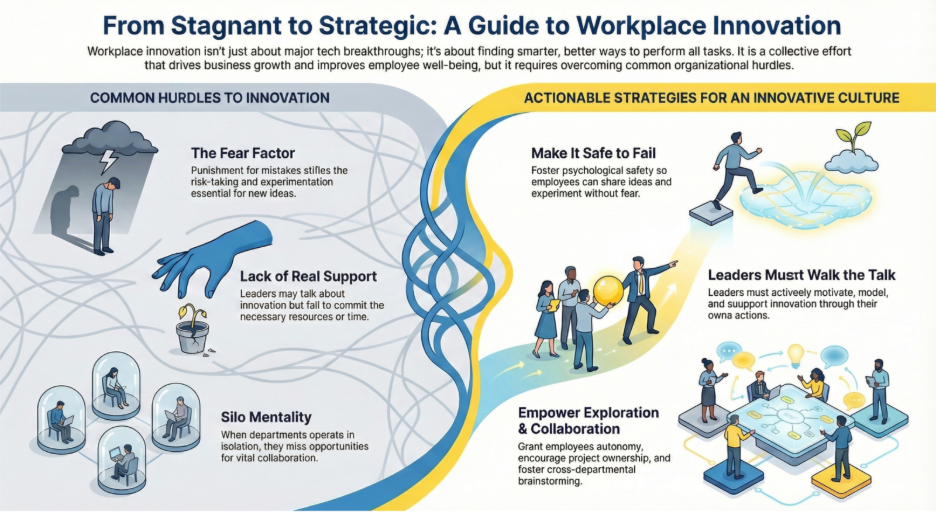
- The Fear Factor: Punishment for mistakes stifles risk-taking and experimentation.
- Lack of Real Support: Leaders who preach innovation but don’t commit resources, time, or champion initiatives.
- Disconnected Efforts: Innovation projects not aligned with strategic goals lose momentum.
- Ignoring the Customer: Creating solutions in a vacuum without understanding customer needs.
- Silo Mentality: Departments operating in isolation miss opportunities for collaboration and idea exchange.
- Short-Term vs. Long-Term: Pressure for immediate results hinders investment in long-term exploratory projects.
- The “Intangible” Challenge: Difficulty in measuring innovation culture to justify investments, though quantification is possible.
- Current Debates: Balancing daily operations with bold experiments, and the debate between dedicated “innovation labs” versus embedding creativity in all teams.
Actionable Strategies to Build Innovation
- Make it Safe to Fail: Cultivate psychological safety where employees can share ideas and experiment without fear. Leaders should model vulnerability.
- Open the Conversation: Conduct regular brainstorming sessions, create digital suggestion boxes, and foster cross-departmental collaboration.
- Empower Exploration: Grant employees autonomy, allow experimentation, and encourage ownership of projects. Consider dedicated time for personal projects or “innovation challenges” (e.g., Google’s “20% time”).
- Cultivate Lifelong Learners: Invest in training, workshops, and resources for creative thinking, problem-solving, and design thinking. Foster curiosity and a growth mindset.
- Celebrate Successes and Failures: Recognize and reward innovative efforts. Reframe failure as a valuable learning opportunity.
- Diversity Fuels Genius: Actively promote diversity in backgrounds, thinking styles, and experiences.
- Leaders, Walk the Talk: Leaders must actively motivate, encourage, and support innovation through their actions, taking calculated risks and learning from mistakes.
- Design for Inspiration: Create physical and virtual workspaces that foster creativity, offering varied environments for focus and collaboration. Embrace flexibility in work arrangements.
- Nurture a Growth Mindset: Help employees view challenges as opportunities and encourage questioning of the status quo.
- Leverage Smart Methodologies: Utilize structured approaches like Design Thinking, Agile, and Lean Innovation to organize creative efforts and align them with business strategy.
The Horizon of Ideas: What’s Next for Creative Workplaces?
- AI as Your Creative Sidekick: AI will automate tasks, provide data insights, and assist in content generation, freeing humans for higher-level thinking.
- Immersive Experiences with VR & AR: Virtual brainstorming, 3D design collaboration, and enhanced visualization will bridge geographical gaps.
- Flexible Work is the New Normal: Hybrid and remote models necessitate advanced digital collaboration tools and redefine connection and innovation across distances.
- People-Centric Focus: Increased emphasis on employee well-being, mental health, and inclusive cultures as foundational elements of creativity and success.
- Skills Evolution: Continuous upskilling and reskilling will be critical to adapt to rapid technological advancements.
- Sustainability & Ethics: Future innovation will be increasingly driven by environmental responsibility and ethical business practices.
- Redefining Leadership: Empathy, adaptability, and authenticity will be paramount for leaders guiding diverse, dispersed, and digitally-enabled teams.
- Strategic Foresight: Organizations will proactively design workplace models to anticipate future needs, experiment constantly, and maintain a feedback loop for continuous improvement.
Conclusion: Innovate or Be Left Behind
Fostering innovation is a necessity for survival and long-term success in today’s competitive landscape. It is an ongoing commitment that benefits both the business and its people.